
by Bob Johnson
When friends who are not from the Inland Northwest visit us, the common refrain is, “You’re out in the middle of nowhere.” To get to our modest abode in the woods, one must traverse a gravel road for three-quarters of a mile, which, we have learned, is a quarter-mile farther than the mail carrier will drive to deliver a package that doesn’t fit in our mailbox that’s among the bank of boxes adjacent to the main (paved) road. Instead of making that four-minute round-trip, the carrier will instead take five minutes to fill out an elaborate form for us to take to the post office in order to claim the package…but not until the next day. This is what is known as government efficiency.
It does suggest, however, that a universal definition of “the middle of nowhere” may exist, although I struggle to understand how “nowhere” – which, by definition, means nonexistent – could have a middle. Regular readers of this column know I have a tendency to digress occasionally, but in this case, the concept of “nowhere” actually is the topic. Specifically, the “middle of nowhere.”
To get to the middle of nowhere, one must first suspend belief and embrace the concept that nowhere is an actual place. A glass of Washington wine, beer, or cider can be helpful in attaining that state of nowhere nirvana.
So can listening to The Beatles’ “Rubber Soul” album: “He’s a real nowhere man/ Sitting in his nowhere land/ Making all his nowhere plans for nobody.” Although, like many Beatles songs credited to the Lennon-McCartney songwriter team, it was John Lennon who penned the lyrics to “Nowhere Man.” And while Lennon never spoke of potent potables from Washington state, he did once say, “We were well into marijuana and nobody could communicate with us because we were just glazed eyes, giggling all the time.”
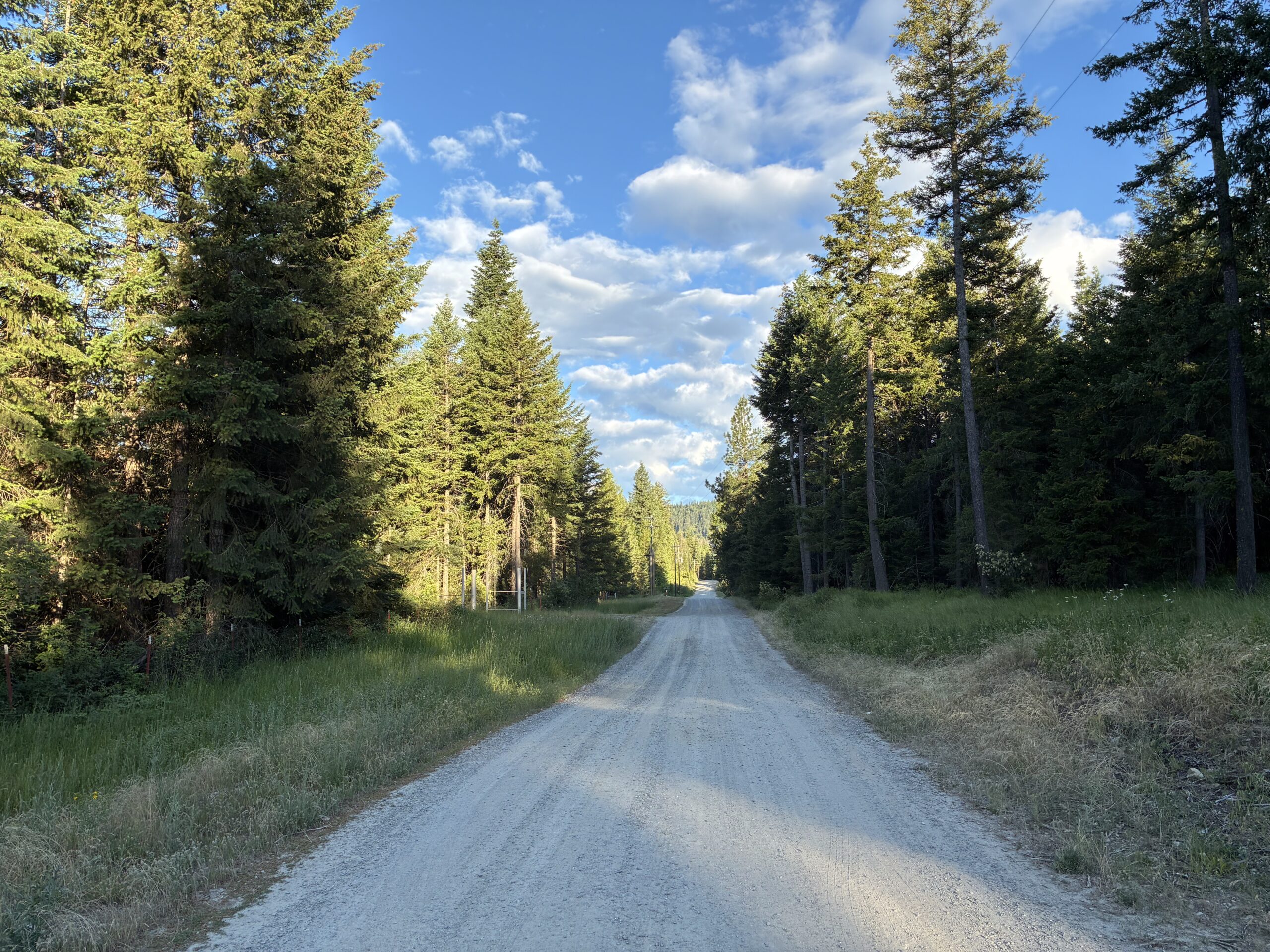
There are many roads in the Inland Northwest that can take a driver to the middle of nowhere.
In other words, they spent a lot of time nowhere. What’s not known is whether Lennon spent any time in Nowhere, Oklahoma, an actual unincorporated community in Caddo County with a population of three to five people, depending on who’s in town and who is somewhere else, which would mean they’re not nowhere.
According to Google Maps, Nowhere can be found at the intersection of E1280 Road and County Street 2550. It is 5.5 miles south-southwest of Albert and 14 miles northwest of Anadarko – which would not put Nowhere in the middle of those two towns, but still make it a place, at least according to contemporary cartographers.
We reached out to the three to five residents of Nowhere, Oklahoma, for comment, but had not heard back at deadline time for this issue of Huckleberry Press.
Back here in the Inland Northwest, one is never far from the middle of nowhere, even if they call the middle of the big city (Spokane) home. For instance, approximately 21 minutes northwest of downtown Spokane (depending on how one hits the lights and dodges the potholes) is Nine Mile Falls. It straddles the Spokane River and is home to Riverside State Park. There, one can hike in peace, ride a horse in peace, or cross the Bowl and Pitcher Suspension Bridge in pure terror.
For the uninitiated, the “swinging” bridge, which connects the park’s day-use areas with the main campground, provides those who dare to traverse it with great views of the adjacent rock formations. Those hanging on for dear life and refusing to look up can still “enjoy” the journey by glimpsing the Devil’s Toenail whitewater rapids below.
Seriously (or as serious as a humor column can be), one needn’t be afraid when crossing the wooden bridge, which was opened to the public in 1998. On the other hand, its design was based on plans for the original Civilian Conservation Corps bridge that was built in the 1940s at a time when most of America’s best architects were serving in World War II.
Another heart-pumping adventure awaits adrenaline seekers at Fisk State Park, about 20 minutes beyond Nine Mile Falls. While most park visitors opt to do the breaststroke, cast a line or paddle a kayak, some head over to an area known as “The Cove.” There, they channel the Acapulco Cliff Diving Championships daredevils once featured on ABC’s “Wide World of Sports” and, if they survive, have a great story to tell their grandkids. The Cove is a remote, unmanaged area, the very definition of being in the middle of nowhere.
On the far eastern side (by most definitions) of the Inland Northwest, the Selway-Bitterroot Wilderness offers endless ways to access the middle of nowhere – which again challenges the concept of “middle,” but I really need to get past that. As one of the largest wilderness areas in the country, if you don’t consider Alaska part of the country, it’s easy to access but challenging to conquer. If you enjoy rugged terrain, swift river crossings, and weather that can change on a dime, SBW (as nowhere experts call it) is the place to go en route to the MOW (middle of nowhere).
Now that we’ve discussed a few of the places one can go to get to the middle of nowhere, we really should consider the mental and psychological aspects of the concept.
For that, we turn to the philosopher Xunzi (born Xun Kuang), who is generally considered the third greatest Confucian Chinese philosopher of antiquity. Xunzi noted, “The person attempting to travel two roads at once will get nowhere.”
As often occurs in philosophy, one observation suggests two more questions. In this case: 1. How is it even possible to travel two roads at once? 2. What means of travel is being utilized?
We reached out to Xunzi for answers and to the greatest and second greatest Confucian Chinese philosophers of antiquity for comment, but had not heard back from any of them at deadline time for this issue of Huckleberry Press.
While awaiting an opportunity to chat with the philosophers, I asked the lovely Michelle to share a few of her favorite middle of nowhere places with me.
“You mean besides our house?” she asked.
“Yes.”
“Let me get back to you on that.”
Could it be that the lovely Michelle is applying to become one of the great Confucian Chinese philosophers of antiquity?
A little while later, she knocked on my office door and said, “I have a few places for you.”
“Great!” I said. “Just in time to make the column. Let’s do it.”
“How about Leavenworth?” she asked.
“I don’t think that’s technically considered part of the Inland Northwest,” I said.
“But it was so much fun, even if it’s not a real Bavarian village.”
“I agree, but there are guidelines I have to follow.”
“I know,” she said with a sigh. “Well, I gave you my best answer.”
“Don’t give up,” I countered. “I’ll take your second-best answer. Even your third best. Remember, I’m on deadline.”
About an hour later the lovely Michelle returned to my office.
“You know when I really felt like I was out in the middle of nowhere since we moved here?” she posed. “It was when we were driving to Canada last summer and we got north of Sandpoint. It was really pretty up there. We’d drive miles and miles without seeing anything but trees.”
That definitely was a fun day trip, even if the Canadian officer working the border check was a grouch. Perhaps he was not fortunate to live in the middle of nowhere and was reminded of that daily simply by driving to work.
Still later, the lovely Michelle returned yet again with one more remembrance of an enjoyable excursion. It was the day we drove down to Cheney and spent a few hours at the Turnbull National Wildlife Refuge. The setting is spectacular and the sheer number of birds we saw motivated me to go on Amazon and purchase the book, The Birders’ Guide to Washington. Now, it’s prompting me to ponder whether birds know, by instinct, how to find the middle of nowhere.
There is not enough space to share all our research on nowhere with you, but it’s obvious to me that nowhere can be reached by most Americans as long as they’re willing to put in a little effort. In some places, such as California, it just takes longer to get there, especially if you’re starting in Los Angeles on a Friday afternoon.
There’s one other thing we can state categorically: Here in the Inland Northwest, when you’re out in the middle of nowhere, you really are somewhere.
Award-winning writer Bob Johnson and his award-winning photographer-wife Michelle have found themselves out in the middle of nowhere often since moving to the Inland Northwest. They say they find nowhere a great place to be.
