
by Robin Milligan
When a job determines whether a family has access to something as important as clean water, integrity matters. The owners of A & H Well Services in Chewelah are dedicated to precision and integrity.
Chris Payne grew up in Chattaroy, Charles Parsons, who goes by Buster, was raised near Oroville, and Andy Peters lived in Nine Mile. Local guys who love this area and care about how they affect the environment and the lives of the people who live here.
A & H was founded in 2019. Peters said had been working well completions in the oil industry previously. He needed a water well tested, but the tester he hired didn’t know the answers to his questions, so he went about finding the answers for himself. He said this led him on the path to the career he now loves, serving the region he calls home, doing what he believes is most important: helping people. According to his partners, he talked them into joining his team, where they share equal authority and ownership over their business.
Payne said he is the pump guy; Parsons drills, and Peters does the estimates and diagnostics. A & H doesn’t just drill wells. They set and fix pumps, test water, fix wells that are not working correctly, and more. They have worked for most of the PUDs (Planned Unit Development), trailer parks, HOAs (Homeowners Association), and water districts. Their focus is residential and commercial water drilling, and they said they are probably the only residential focused company with an engineer on staff in the area. They care about the quality of their work and every one of them are serious about making sure the work they do is done right the first time.
Working across northeastern Washington and Idaho means working in diverse geology: shale, granite, alluvial soils, and basalt zones.
“This area is unique in that there are transition areas where we encounter basalt flows and granite and they are very different and present their own unique challenges. You get into the basalt flows and then you get into an overburden from the alluvial glacial lake Missoula, where we have encountered over 100 feet of sand and then clay and more sand,” Parsons said. The sand and clay layers Parsons described trace back to the Ice Age floods from Glacial Lake Missoula, which shaped much of eastern Washington’s geology.
“Getting from jo b site to job site can be tough at times because of simple access issues. Trees might need to be cut. We can give an educated guess as to what we’ll encounter. We want to do good work and be transparent about what it will cost and the outcome we’ll achieve. We want the customer to feel confident that our estimates are as close as possible and never go over budget without the customer’s direction,” he said.
Groundwater, Parsons explained, is often misunderstood. “People tend to think of groundwater as a lake, but it is more like a sponge. It’s about permeability, and that can cause problems because it affects the recharge rate of a finished well.” The recharge rate is how quickly a well fills back up when empty.
When the geological formation is uncertain, the stakes are high.
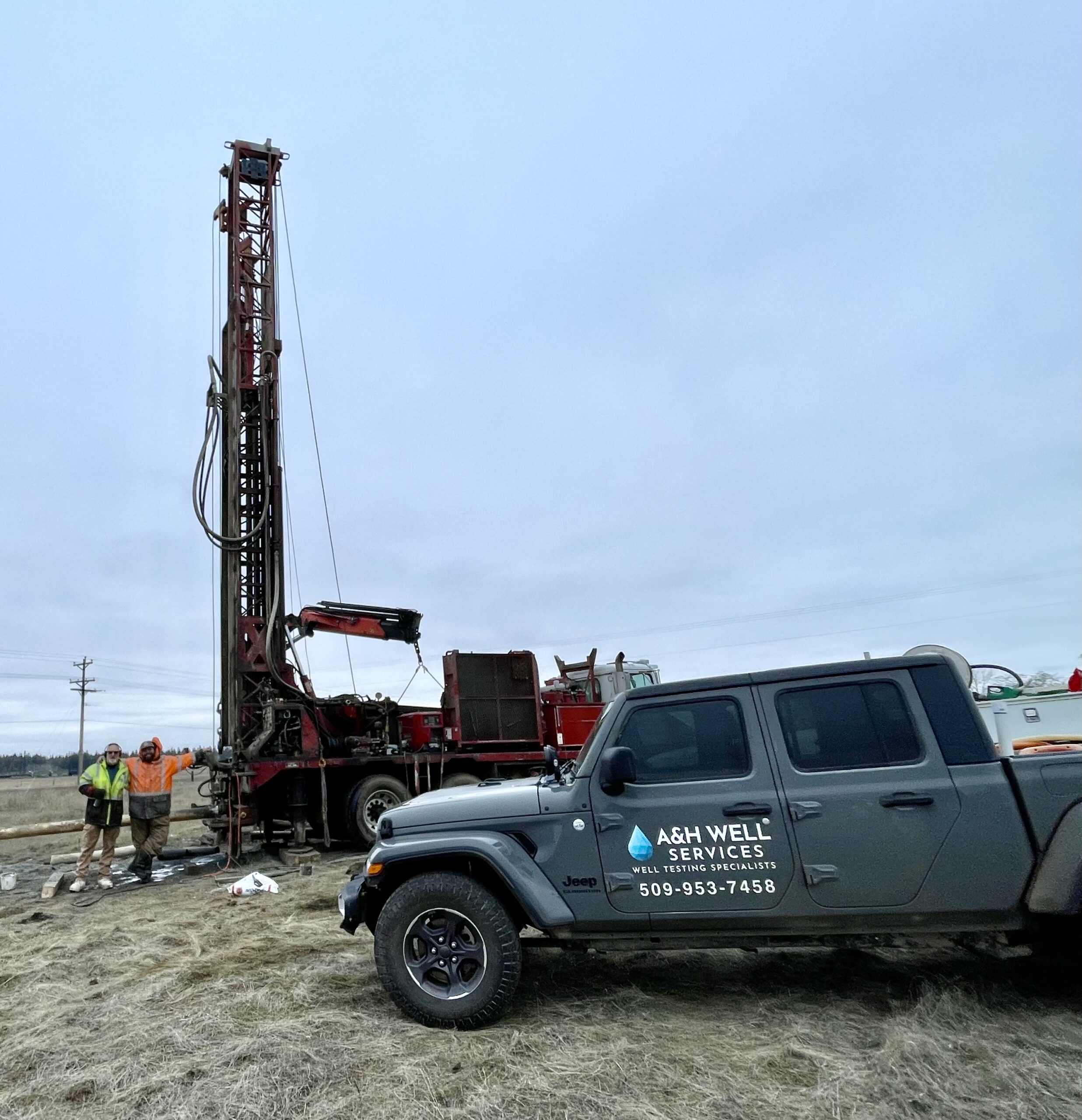
Parsons said, “I always explain that drilling for water can be a gamble. I will investigate every change in the formation to determine the best course of action for the customer. We focus on the quality of the finished product over getting the job finished quickly. It’s a huge investment for most people. The customer is often putting everything they have on the line for their future. For us, it’s about answering all of their questions and being forward about reasonable expectations.”
Since 2020, the amount of people making those investments have increased dramatically. “The data says it clearly,” Peters said.
For rural families, a well can mean more than infrastructure. A well means water Independence and the ability to have fresh, clean drinking water. “Many of our clients have a hand pump option installed or generators to keep the flow going even when the power is out,” Peters said.
This independence does not mean unlimited supply. Peters explained what can happen when wells decline, “The more people who drill into an aquifer, the less overall water that exists for everyone tapped into that same water supply. Wells can decline with age, and when they are improperly installed it can be a big problem.”
Parsons added, “During droughts, wells can run low or out of water, so more drilling to reach deeper water can often be the answer. Depending on the original construction, it can possibly be deepened, but sometimes you have to start over and drill a whole new well.”
He continued, “On an industrial level, if a farm has a water right, it should stand, and individuals have the right to have a water well on their property. I am a believer that the state is doing a good job with the regulatory system we have.”
The owners said certain formations present particular environmental and financial risks.
With Basalt, the solution is to go deeper, which can be cost prohibitive. It can contain pollutants or contaminants, especially within the first 300 feet.
A well drilled in shale can seem like it’s going to be fine, but then wane because of its softness. Shale is a sedimentary rock. The softer the formation, the more possible it is that it will seal itself off in time when the clay absorbs water and swells into the fractures in the stone. Highly fractured, soft bedrock can also collapse into the well just like clay or sand layers, so that has to be accounted for as well.
Granite can also be tricky because it does not contain as many fractures as shale, but some of the fractures hold water but don’t conduct water. Like shale, though, softer rock contains clay and makes it harder to get water out. Medium-to-hard granite stays open the best, conducting water better.
When asked how much water is enough for the average family, Peters said, “The EPA (Environmental Protection Agency) and USGS (U.S. Geological Survey) both roughly agree that 82-100 gallons per person (GPM) is necessary. If a well gives three gallons per minute or less, you’ll need storage. Five GPM needs a deep well, and seven GPM or better is good.”
Groundwater is a shared and finite resource that A & H Well Services takes very seriously. Water quality remains central to their work.
“Water is public, finite, and we should be good stewards and protect the ground water from contaminants,” Peters said. “’PFAS’ (per- and polyfluoroalkyl substances) is a current worry affecting water quality. These can come from shampoo, outdoor wear, cleaning products, Teflon cookware, and many other products prior to 2010. This is part of a broader national drinking water concern. I worry that because the thresholds for testing are very low, and old wells are being pulled offline because of it. I see this becoming more of an issue concerning older wells in the near future.”
Parsons said, “People need to be aware of protecting their resources. We have an issue with a contaminant called ‘PFAS’ is a forever chemical. It is everywhere, not just here, and can be found in many products. High nitrate content from fertilizers and naturally occurring sources, phosphorus, uranium, and arsenic can also be problematic. It’s important to get your water tested, although it may not be required.”
Water testing often happens before the sale of a property with a well. Peters said he tries to get people to test water on their own many times, so he isn’t charging to take a sample to the lab and says that everyone who gets a well drilled should also get their well water tested. He recommends taking your water sample to Anatek in Spokane because they are the most reputable.
“I’m not in the business of selling hope,” Peters said. “I give you options and show you the data that exists, but it’s always possible that you’ll get a dry hole. We tell customers that upfront.”
He continued, “A deeper hole doesn’t always have the effect of more water. The first 300 feet in granite for instance often has most fractures because it cooled the fastest. A deep well does hold more water, but the pump will cost a lot more and doesn’t always translate to being cost effective. We’re honest. Communication is so big. We’re blunt about the reality of the situation. People’s lives are on the line.”
That sense of responsibility is built into everything they do.
“it’s interesting,” Peters said. “Always a little bit of a different problem at each place. Growing up on a farm, my uncle told me the only thing people will remember about you is how you treated them. We try not to charge for simple service calls if we don’t have to. That’s how we do business. We give a written estimate before we do anything. We sell a good product and we stand behind it. We show up, are polite, diagnose the problem, and even if we can’t fix it today or the customer doesn’t go through us, helping people feels good. The customer experience being positive is important to us. It matters how you treat people.”
Parsons agreed, “I’m a simple man. I can pound nails, chase cows, or do this. It’s something I’m good at. I enjoy the challenge; no two days are the same. Never facing the monotony of the same thing day after day. Sometimes the work is straightforward and sometimes it’s trigonometry. It’s an interesting job and never boring.”
In a region where water feels abundant, the message beneath the surface is clear.
“Water is a precious resource,” Parsons said.
In northeastern Washington, the health of the region depends not only on what lies underground, but on the integrity of the people trusted to reach it.
A & H Well Services
2710 Quarry Browns Lk Rd.
Chewelah, WA
509-953-7458
www.aandhwellservices.com
Robin Milligan is an artist and entrepreneur living in Spokane, Wa. She curates art shows, runs an IT company, and teaches ceramics and painting from her home studio. When not working, Robin spends her time with her three children exploring nature, rockhounding, making art, and swimming.
