
Alex Chaoukouri
Readers are likely familiar with railroads. Whether from history lessons about the Transcontinental Railroad in middle school, or the trains that seem to block the road specifically when you are in a rush, we are surrounded by these metal titans. However, there is a railroad car in our midst with significant historical value and prominence: the Pullman Car Company’s Abraham Lincoln, also known as Denver and Rio Grande Western Railroad Business Car No. 101. Here in eastern Washington is one of the most unique railcars in American history, with a legacy so fascinating that it earned a place on the National Register of Historic Places.
The title of the car may be misleading, since President Abraham Lincoln was long gone and buried by the time this railcar came to be. But, at the very least, there was one Lincoln involved: his son, Robert. While the father helped open the West to railroad expansion by signing the Pacific Railway Act of 1862, the son became president of the Pullman Car Company in 1897, heir to both the Lincoln name and the company’s powerful hold on sleeping cars. Thirteen years after Robert Todd Lincoln took over the presidency, the Pullman Car Company made an abrupt pivot from 60- foot varnished wooden railroad cars to an 80-foot, riveted-steel design. In September of that year, coach 895 was manufactured for the Western Pacific Railroad. It was configured as an 84-seat passenger car and featured some of the most modern features of the era, including electric lighting.
By 1929, coach 895 had been retired from Western Pacific service and was purchased by the Denver & Rio Grande Western Railroad Company (D&RGW), where it would ultimately be rebuilt into self-contained business car No. 101 for use by the railroad president and other officials. The rebuild completely transformed the car, adding office space, two staterooms (one with an attached bathroom), a hallway bathroom, a dining room, servants’ quarters, a kitchen, and the all-important observation area. It even had air conditioning and steam heat. That’s what I would call riding in style.
The D&RGW held on to the railcar until 1964, when Golden West Rail Tours bought it and used it for nearly two decades before it was sold for scrap value.
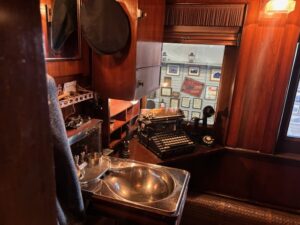
While in Golden West Rail Tours’ care, business car No. 101 accrued depreciation of $44,409.60, equivalent to $481,640.08 in 2026, giving it a net value of $3,250, equivalent to $35,247.56 in 2026, according to Edward Furey of calculatorsoup.com. It seemed that all hope might be lost for our coach protagonist, yet the tale was not over. In 1983, Curtis Andrews purchased the car from a Los Angeles scrapyard and sent it to Tucson for eight months of extensive mechanical rebuilding to bring it up to Amtrak standards. Finally, Andrews gave the car a name to carry for the rest of its lifetime, titling it the Abraham Lincoln to honor both the president of the United States and the president of the Pullman Car Company. In 1988, the Abraham Lincoln railcar was listed on the National Register of Historic Places and was recognized as the oldest operational car in America allowed on tracks run by Amtrak.
Three railroad companies and two rebuilds later, the Abraham Lincoln now lives in Othello, Wash., and is available for private tours. It is also on loan to the Inland Northwest Rail Museum at 27300 Sprinkle Rd., Reardan, and available for public viewing through July during museum hours, Thursday-Sunday, 10 a.m.-5 p.m. Call 509-796-3377 or visit inlandnwrailmuseum.com for more information.
With all the frustration some of may feel toward trains that cause delays in our day, not to mention their ear-splitting whistles, we might take railroads for granted. While a handful of people living in the Pacific Northwest can say their families trekked the Oregon Trail in covered wagons, braving the wilderness in the name of expansion and prosperity, many others of us probably would not call this place home without the railroad boom of the late 19th century. The Union Pacific Corporation is especially close to my own heart because of my grandfather’s work in communications for the company. Either way, living in the Pacific Northwest gives each of us an intrinsic connection with the railroads that connect our cities and towns.
Alex Chaoukouri just graduated from Central Valley High School with honors and will be attending the University of Washington in the fall to study law.
