
Ray Bilderback
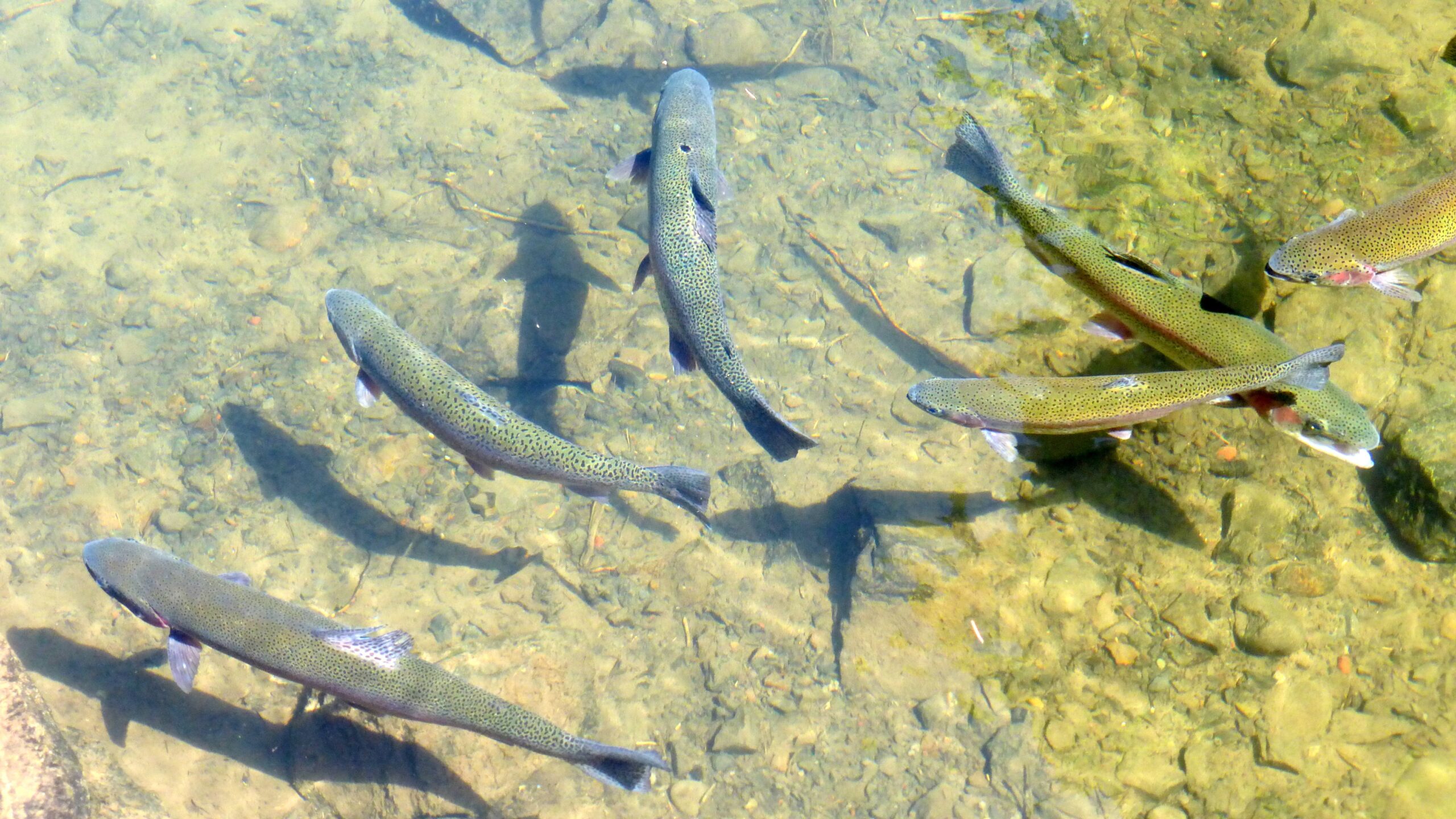
Izaak Walton in the Compleat Angler insisted that “the trout is the tastiest of the fresh water fish…a fish that feeds clean and purely, in the swiftest streams, and on the hardest gravel.” That goes a long way to explain why a fisherman would fish the small brushy streams of eastern Washington.
Let’s enumerate the good points of such streams:
1. The fish are tasty
2. The streams are usually crowded with hungry fish (lots of action) and uncrowded with people
3. There are probably one or two small streams near you and, as Walton noted, the water is cold and pure. Some small streams have sections that are not brushy. Lucky you!
There are also disadvantages when fishing more popular streams: mosquitoes, “no-see-ums,” slippery rocks, and so on. Additionally, the brushy stream demands more patience: tangled lines happen more often, the fish tend to be spooky, and you have to catch so many small fish to satisfy the size limit of 8 inches. And in the 2025- 26 regulations, you may only keep two trout in streams and beaver ponds.
On your way to keeping two legal trout, you must turn back many small fish. To release them safely, wet your hand when handling them. Also, and this is crucial, use a barbless hook about size 12 or smaller. It upsets me to see fish torn up and discarded because they were not legal size and because barbless hooks were not used.
On small, brushy streams, I use a short rod, a short leader with no sinker, and small fly. To protect myself from brush and buzzing insects, I wear long pants and long-sleeved shirts. A dull, colorless outfit is best, not white. I have tested the matter. Wearing a white shirt, I’d fish two holes and count the strikes, then take off my shirt and count the strikes in the next two holes. The white shirt was a clear loser.
Sometimes I use grasshoppers on a bare, barbless hook and a method called “dapping” which is described in Walton’s 17th century book on the subject of angling. The fish can be spooked so you have to approach the hole very carefully. I prefer to fish upstream because, if I muddy the water, I muddy the hole I have already fished.
Don’t trust rocks. A couple of bad falls have taught me to secure good footing. Stay still and observe the fish. You may have to wait 15 minutes or more, but the fish are hungry and will soon be back in a feeding mood. With your fly or grasshopper a foot or so above the water, maneuver it a bit upstream of a likely fish and dip it into the stream. Lightly now. No response? Raise your fly, or hopper, wait a bit then “dap” it again. You will get action.
 I prefer dry flies because it takes so many grasshoppers and you spend so much time re-baiting your hook. When I was a kid, we didn’t know about fly fishing, so grasshoppers it was. We stored them in a Prince Albert tobacco can that was easy to carry. Come to think of it, a big part of grasshopper fishing fun is gathering the bait. We would go to a field of dry grass and, armed with worn out brooms, whack grasshoppers until the can was full.
One more note on fishing gear: use a small net. This allows you to keep the fish in the water while measuring it and (usually) releasing it. If you are using barbless hooks, once netted, the fish is usually free of the hook in the bottom of the net and doesn’t need to be handled.
Most hooks come with a barb. To create a barbless hook, use a pair of needle-nosed pliers and squeeze the barb until it is just a bump.
Once upon a time, when I was a kid, three families of neighbors camped together on a mountain meadow with a lake nearby. Fishing was good, but catching was poor in the lake and there were seven or eight kids to feed and a half dozen adults. So, on the third day, four of us drove to a mountain stream that was full of eager fish. I was the oldest boy and got invited with the men. The stretch of the creek they gave me was crowded with alder and willow brush. At that elevation, the heavy snowfall bent the brush out over the stream, creating a tunnel. I had to fish bent over and dapping was the only possible choice. I got a strike every time my fly hit the water, but I had to bring the rod back hand-over-hand until the fish was in my grasp. I lost far more fish than I caught. Oh, what I’d have given for a net.
A couple of hours of frustration later, I heard my father talking to someone, so I crawled out of the tunnel. I had eight fish and the three adults had their creels full of 8-10-inch trout (there was a 15 fish limit in those days). I felt skunked. But we had a great fish feed that night and stories to tell.
Back to the present: if you are bent on filling your creel with small, tasty trout, consult the fishing regulations for streams. You will note that some streams allow an unlimited number of eastern brook trout with no size limit. Be sure you can easily identify a brook trout because bull trout, which sort of look like brookies, are protected.
I line my creel with dry grass and green leaves. This method keeps the trout fresh while on the stream. When I get home, I clean the fish and get them into cold water. A basin or bowl with ice cubes and water will do nicely. Prepare a clean paper bag with seasoned flour (salt, pepper, and flour). Put a fish in the bag and shake until it is lightly floured. Repeat for each fish. I like to use a cast iron frying pan with a small amount of olive oil. Think a bit less than medium heat for a few minutes on each side. They are nice paired with a crisp salad or on a bed of rice. Bon Appetit!
Ray Bilderback, creator of the Reuben Braddock novels, was born and raised in the Sierra foothills of California. He served in the U.S. Navy Seabees during the Korean War and taught for many years in the west. He makes his home in the mountains of eastern Washington with his archeologist wife, Madilane Perry. “In the 1930s and 1940s, where I lived, we still used horses and hand tools, canned and preserved what we grew or raised, lit our kerosene lanterns, stoked our woodstoves. In my writing, I draw from those times like water from a sweet well.”