

by Bob Johnson
I was promised a moose. In fact, I was promised a moose once before, so this is nothing new. Are moose promises legal and binding, or are they merely lures to convince unsuspecting city bumpkins to visit cold places or move out to the country?
The first moose promise was made by the lovely Michelle several years ago when she was trying to convince me that we should plan a trip to Alaska to see her cousin. “Captain Steve,” as he is known in and around the community of Ninilchik, runs a fishing lodge and takes guests out on the ocean in search of halibut, salmon (king, silver and sockeye), lingcod, and rockfish (black and yelloweye).
I used to fish off a pier, but no amount of Dramamine could keep me happy on the sea, even in calm waters.
“You don’t have to fish,” Michelle said. “It would be about some beautiful scenery (it’s a three-and-a-half-hour drive from the airport in Anchorage to Ninilchik), some great food (the lodge feeds breakfast and dinner to its guests) and spending time with my cousin.”
Michelle sized me up as I pondered the potential itinerary. Sensing I wasn’t completely convinced, she added, “Plus, you’d get to see moose.”
There it was: “You’d get so see moose.”
Not, “You might get to see moose.”
Not, “There’s a chance you’ll see moose.”
No, Michelle said, with no degree of uncertainty, “You’d get to see moose.”
And because she didn’t include an “a” before the word “moose,” the implication was that I’d see multiple moose.
Michelle knew she’d played her best card because she also knew that I was a big fan of “The Adventures of Rocky and Bullwinkle” when I was a child. Specifically, I was a fan of Bullwinkle J. Moose, who was dimwitted but good-natured. He also was a punster. In other words, Bullwinkle was me.
“So, you’re telling me I’m guaranteed to see moose while we’re there?” I pressed.
“Guaranteed,” Michelle said.
“Okay, let’s check air fares.”
Michelle was right about the scenery. The drive from Anchorage to Ninilchik provided vistas that were beyond beautiful. It was breathtaking.
She also was right about the food. In fact, one of the dinners at the lodge would rank among the top five of my life. It began with a creamy halibut chowder, proceeded with halibut/lingcod ceviche, and concluded with a well-seasoned (but not overly seasoned) halibut filet. Yeah, I’m a halibut guy.
But I had come to see moose. Around town, animated moose were featured on several business signs. A laundromat’s sign had a drawing of a grinning moose in a bubble bath. The McDonald’s in the neighboring town of Homer had a drawing of a moose on one of its advertising signs. I asserted that those did not count.
“Just wait,” Michelle said. “You’ll see one.”
Aha! She had meant a singular moose all along.
The days passed. We enjoyed more great meals at the lodge, spent quality time with Michelle’s cousin, went on a few drives, and even visited a winery that crafted sweet wines out of any fruit you could conjure, except grapes. But no matter where we went, there were no moose to be seen.
We made the long drive back to Anchorage and the semi-long flight home. It had been a great trip – but a completely moose-less one.
Not one to hold a grudge, I hadn’t given that incident much thought in the ensuing years – not until we had decided to move to the Inland Northwest and were trying to figure out where we should live. Unlike where we’d come from, “country living” was an option on the table.
As we weighed the pros and cons of the various cities and towns, as well as the type of dwelling, Michelle suggested that “living out in the country” might be fun. I did not disagree with that, as we’d grown weary of having neighboring houses that were less than 10 feet apart in the urban sprawl we were abandoning.
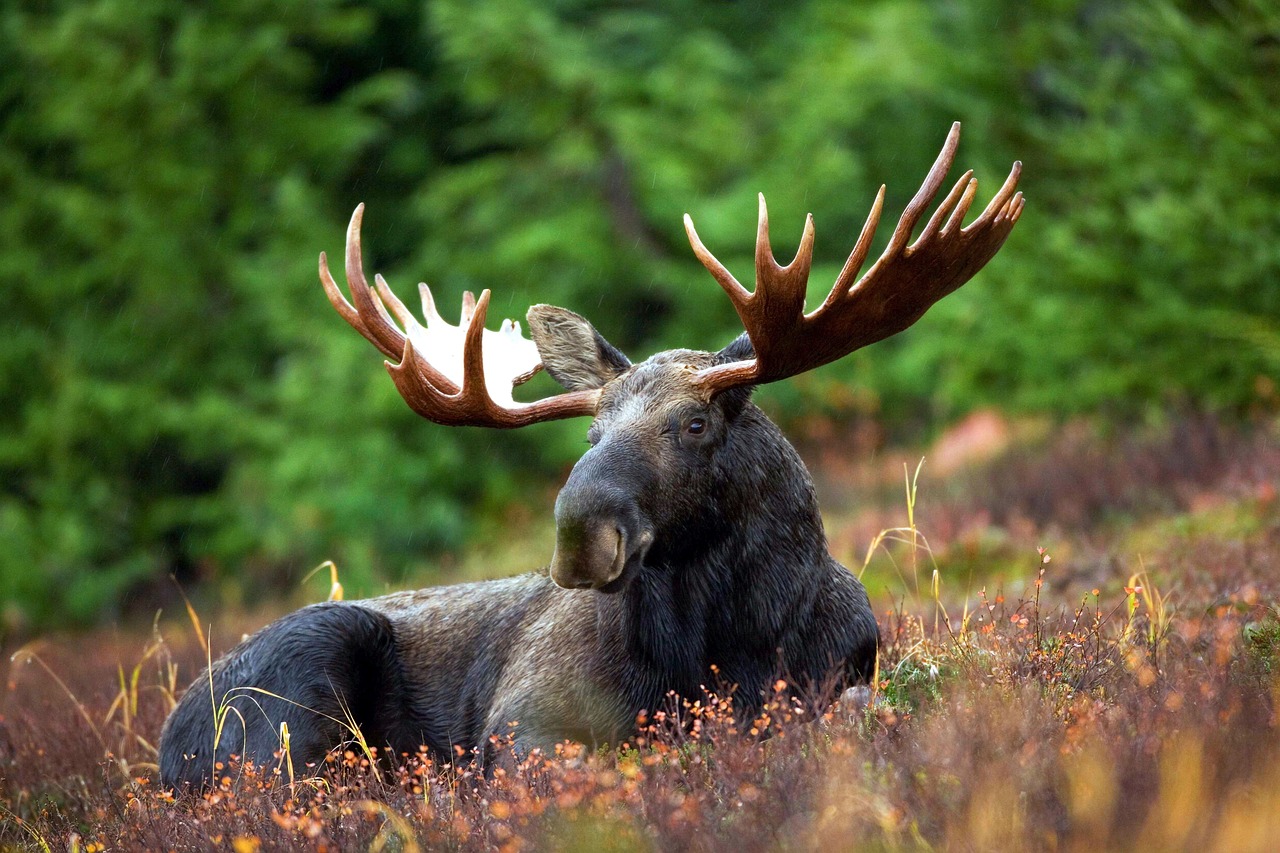
There were other benefits, she added. We’d get to enjoy beautiful scenery every day. There would be hardly any traffic. We could see the stars at night.
And then, saving the best argument for last, as all great debaters do, she said, “Plus, you’ll get to see moose all the time.”
As my memories of the failed Alaska trip came rushing back, Michelle could see that I was incredulous. But she was ready.
“We can even talk to the contractor about placing the house so your office is facing the woods where the moose live,” she said.
“How would he know which direction that is?” I retorted.
“He’s been talking to our neighbors.”
Great. Neighbors on two and perhaps three sides of us already were figuring that the new guy moving into the neighborhood was some kind of moose nut job. And we hadn’t even bought the land yet.
But there was no turning back. Our former house sold quickly, we put most of our earthly belongings into storage, and we made the move north. We bought the piece of land in question, and lived first in a cottage, then in an apartment and then in a motel until our new place was ready to occupy.
During our apartment dwelling days, Michelle and I took a walk around downtown Coeur d’Alene one day. Right on the main drag, we came face to face with a bronze moose statue. Before Michelle could open her mouth, I said, “Nope. Doesn’t count.”
Further investigation revealed that the bronze moose has a name (Mudgy) and is one of five such statues along “The Mudgy Moose Trail” developed by the Coeur d’Alene Parks Department to further confuse and mislead city bumpkins into considering a move to the area.
Our new house is fronted by a dirt road that’s accessed by a two-lane highway and has state park land in the rear. On either side, dozens of rows of tall evergreens separate us from the neighbors, who already think they know more about me than they should. And, no question, my home office has an outstanding view of the surrounding timberland.
Six days into the new year, it started snowing at 8:30 a.m. and didn’t stop until after 7 p.m. I know this because I had a front-row seat from my office. At times, the snowflakes floated to the ground and at other times they were whirled around by gusting winds. By sunset, the house was surrounded by a thick layer of white.
I do not “touch type” – that’s for people who like to show off – so I would type a sentence or paragraph and look up, then repeat, all day long. Every so often, I’d focus on the trees a hundred feet away, hoping to see that promised moose. One never materialized.
The next day, one of our new neighbors brought over a housewarming gift. As the conversation went on, Michelle knew what I was going to do.
“So, I hear we have moose around here,” I said.
“Oh, yes,” the neighbor replied. “One time, when my husband was out of town, I was out in our hot tub, and a moose came right up to me.”
“What did you do?” I asked, surprised by her affirmative answer.
“Well, they can be mean, you know,” she said. “I just tried to stay calm, spoke very calmly to it – you know, ‘Nice moose…’ – and slowly made my way back to the house. We’ve had lots of sightings through the years, but that was the closest I got to one.”
I didn’t respond immediately. Had Michelle put her up to telling this tall tale? Or could it have been true?
Finally, I said, “Wow.”
The days went by. Some were snowy. Some rainy. A few sunny. Their one commonality: no moose to be seen. Not from my office. Not through any other windows in the house. Not along the dirt road connecting our home to the main drag.
My thoughts wandered back to my childhood. I knew then and know now that Bullwinkle J. Moose was a cartoon character. But didn’t he have to be based on something? You know, like a moose?
One occasionally reliable source, Wikipedia, has an article about moose which describes them as “the world’s tallest, largest and heaviest extant species of deer.”
Wait – a moose is a deer? They never taught us that in the city school I went to way back when. Now I’m more confused than ever.
But one thing remains crystal clear: I was promised a moose.
And until I see one, I can only consider the trip to Alaska and our move to the Inland Northwest woods to be moose ruses.
When not looking for moose, award-winning writer Bob Johnson and his award-winning photographer wife, Michelle, enjoy exploring their new and final home in the Inland Northwest and sharing their observations with Huckleberry Press readers.
